
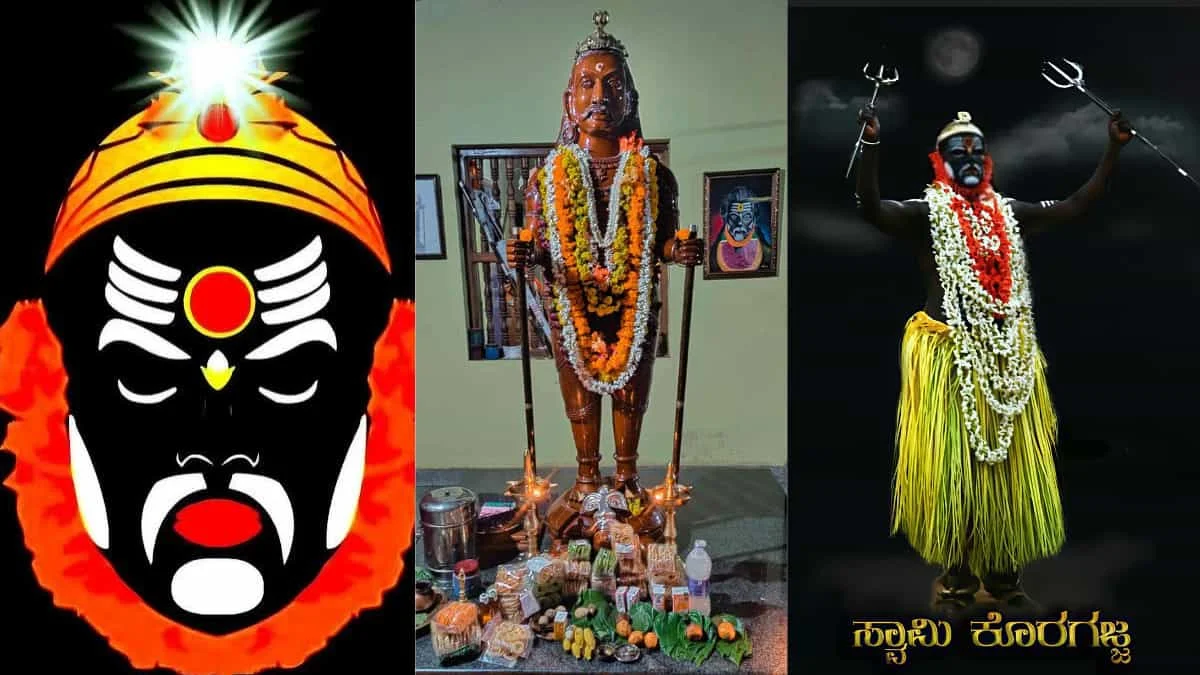
Discover the true story of Koragajja (Koraga Thaniya) – one of the most worshipped Daivas of Tulunadu. Learn about his origin, struggles, divine transformation, and why people offer alcohol to Koragajja during kola.
Among the many Daivas worshipped across Tulunadu (Tulu Nadu), Koragajja holds a very special place. People across the coastal belt recall him for blessings in all aspects of life. Whether something is lost, a work needs to be completed, or any problem arises – the first divine figure people seek is Koragajja.
Unlike mythical gods, Koraga Thaniya (Koragajja) was a historical figure who attained divinity due to his extraordinary deeds, compassion, and struggles. His story reflects the Dravidian tradition of ancestor worship, where individuals who contributed greatly to society were revered and remembered for generations.
 WhatsApp Channel
 Telegram Channel
Who is Koragajja? Meaning and Significance
The name Koragajja comes from two words:
- Koraga → Name of the community.
- Ajja → In Tulu language, it means an elderly man or grandfather.
Even though Thaniya attained divinity in his middle age, people lovingly addressed him as “Ajja” out of respect and affection.

Early Life of Koraga Thaniya
- Koraga Thaniya lost his mother Maire when he was just 30 days old.
- Later, he also lost his father during childhood, leaving him orphaned with no one to care for him.
- With no family left, he left his hometown and journeyed south in search of survival.
Near Kallapu, Thaniya sat under a tree where people often passed by.
- Due to hunger, he started eating white sand imagining it as rice.
- He consumed Careya arborea (wild guava) as if it were coconut.
- Sometimes he laughed, sometimes he cried – a reflection of his loneliness.
Encounter with Bairakke Baidyedi
One day, Bairakke Baidyedi, along with her daughter Athu Baidyedi and her brother Chenniya, passed by carrying toddy (kali) pots. They observed Thaniya’s strange actions.
- The child (Athu) got frightened and hid behind the fence.
- Thaniya refused to move from the fence because he had no cloth around his waist.
- Out of compassion, Bairakke Baidyedi removed the cloth tied to her pot and gave it to him.
Hearing his story of being an orphan, Bairakke took him home and promised to treat him like her own son.
From then onwards:
- Her house began to prosper.
- The family’s toddy business flourished.
- Thaniya also excelled in basket weaving (basketry) – which is still symbolically represented in Koragajja kola, where the basket is hung on the shoulder of Koragajja.
The Incident at the Daiva Nema
During a grand Nema (ritual) for Daivas – Marlujumadi, Maisandaya, Lekkeshiri, and Kinnikodangade, offerings had to be carried from Ansuru Barike (Bairakke’s house) to the temple.
- The items (coconut leaves, tender coconuts, banana plants) were so heavy that seven people were required to carry them.
- With no one available, Bairakke requested Thaniya.
- Thaniya agreed on one condition – he should be served a meal meant for seven people (rice, toddy, and curry made of 30 mackerel fish).
After eating, Thaniya lifted the entire load alone, proving his divine strength.
Before leaving, he emotionally told Bairakke:
“Mother, you nourished me like your own, but do not expect me to return. One who leaves showing his back might never come back showing his stomach.”
Discrimination at the Temple
When Thaniya reached the temple carrying the offerings:
- The chief of the temple insulted him, asking him to keep the things outside and stay away as he belonged to a lower community.
- Thaniya felt deeply hurt and asked:
“The offerings I carried are accepted, but not me? Am I rejected because of my caste?”
His words were ignored.
Still, Thaniya stood near the temple and noticed fruits on the branches above. Recalling that his foster mother needed pickle, he tried plucking them:
- He placed one foot on the temple strain.
- Unable to reach, he placed another on the temple kalasha.
This act angered the divine inside the temple, and Thaniya disappeared (attained divinity).
How Did Koraga Thaniya Die?
The exact reason is unclear:
- Some say he was killed by people because he touched the sacred temple structure despite being from a lower caste.
- Others believe he fell accidentally while plucking fruits.
Since pardanas (oral epics) were never written down, the story has been modified over generations.
Koragajja and the Arasu Daiva
Once, Arasu Daiva tried to claim Sarlapatta (divine position). But if Arasu Daivas occupied that role, Panjanthya Daiva’s position would change.
So, Panjanthya requested Koragajja to stop them.
- Koragajja killed a cow (kubalthi petha) on their way, as Arasu Daivas (being offered vegetarian food) could not step past impurity.
- Hence, Arasu Daivas had to leave.
Panjanthya blessed Koragajja and granted him:
- Worship in seven sacred stones across Tulunadu (Manja, Bolya, Agela, Ujjila, Tala, Derlakkatte, Someshwara).
- The Sarlapatta position.
Why Do People Offer Alcohol to Koragajja?
Since Bairakke Baidyedi was a toddy seller, she often gave toddy (kali) to Thaniya. Over time, people started offering palm wine to Koragajja. Later, this tradition extended to other alcoholic drinks.
Why Were Women Restricted from Watching Koragajja Kola?
During Koragajja kola:
- The performer (medium of Koragajja) wore only palm leaves around the waist.
- He danced to drum beats (dollu) while narrating the story through pardanas.
- Alcoholic offerings were also made.
- The rituals were performed with minimal lighting.
Because of these reasons, women were traditionally restricted from witnessing Koragajja kola.
Transformation of the Story Over Time
Sadly, in modern times, the story of Koraga Thaniya has been mythified. Many now believe him to be an incarnation of Lord Shiva, ignoring his historical roots.
This distortion happened because:
- Communities belonging to lower castes were marginalized and barred from temples.
- Their true history was altered to fit into mainstream religious beliefs.
As a result, many people today struggle to accept the story of Koragajja without divine connections to gods.
The story of Koragajja (Koraga Thaniya) is not just about divine worship but also about struggles, discrimination, compassion, and transformation.
He represents:
- The power of truth and resilience.
- The rich tradition of ancestor worship in Tulunadu.
- A reminder that real historical figures can become divine through their deeds.
The main intention of retelling this story is to preserve its originality for future generations without degrading or glorifying any community.
Read More: Pilgrimage Tourism & Temples English Blogs:
The Temple Where Wishes Come to Life with Clay: Unveiling the Mysteries of Surya Temple, Ujire
To get instant Pilgrimage Tourism & Temples English Blogs notifications like this! Join the WhatsApp & Telegram groups. Click to Join Below Button
 Facebook Page